Beyond this bold goal lies the future of shochu production.
What is the sustainable energy cycle envisioned by Kirishima Shuzo?
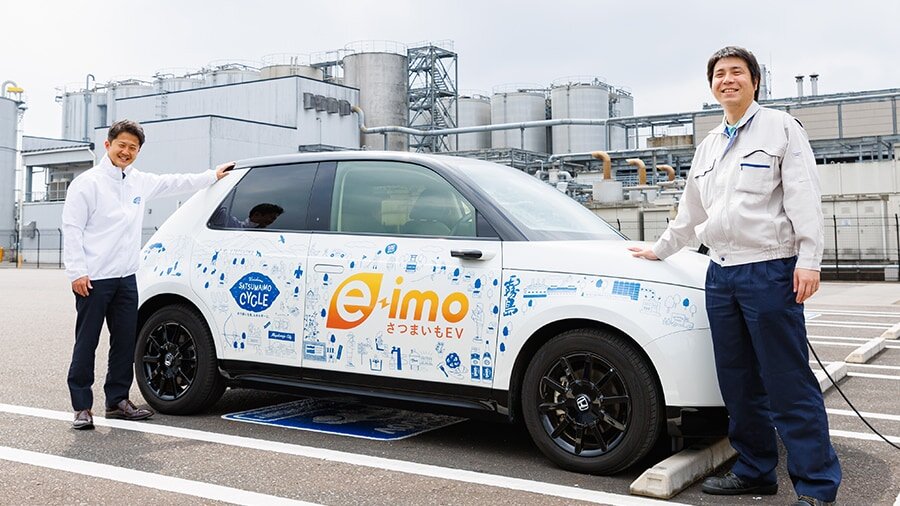
Kirishima Shuzo has a company car that runs on electricity made from sweet potatoes, the " Sweet Potato EV e-imo" (hereafter referred to as "e-imo"), which was developed as part of the "KIRISHIMA SATSUMAIMO CYCLE (hereafter referred to as "KSC") project.
We spoke to Hiroaki Hasegawa of the Planning Office and Junpei Hayashi of the Green Energy Department about the idea behind the KSC project.

KSC was launched as a project in 2019, but environmental initiatives have been ongoing for a long time.
"At the core of it all is the idea that shochu lees are a treasure," says Hasegawa. Shochu lees, a by-product of shochu production, are generally disposed of as industrial waste, but Kirishima Shuzo has always considered it a "blessing from nature." This is why the company continues actions that foster a cycle, such as making effective use of it by Sweet Potato Power Generation using biogas.
As an extension of these activities, the company publicly announced the KSC project in November 2021, with the aim of continuing to circulate positive energy, centered around sweet potatoes. At the same time, the company also declared that through the realization of the project, it aims to achieve virtually zero CO₂ emissions from its factories and offices by fiscal 2030.
This announcement was also not an easy one.
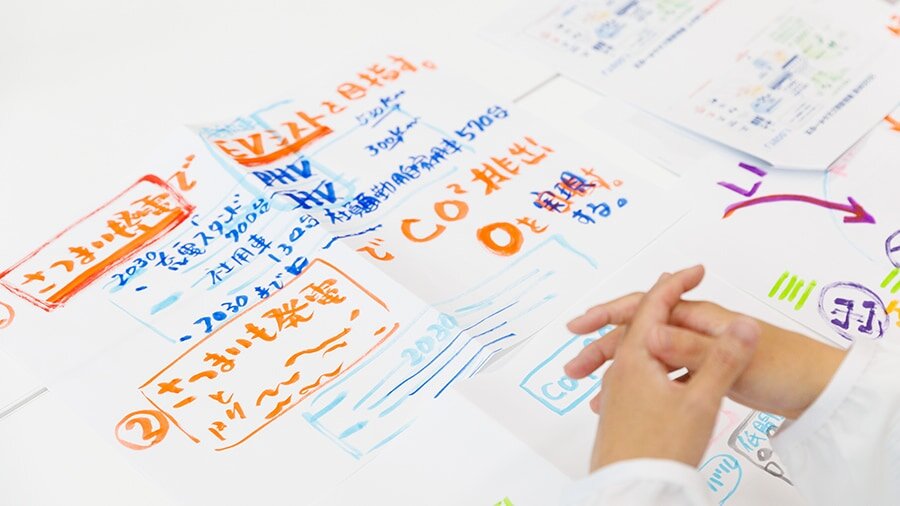
"Initially, we set a goal of achieving net-zero CO₂ emissions by 2050 and proceeded with preparations. However, as the announcement drew near, opinions were raised that we should set a bolder target, so we quickly brought the date forward to 2030 and moved forward with our plans," Hasegawa recalled.
With 2030 as the target, there would only be several years to achieve the goal. The hurdles were so high that discussions had to be held day and night at a rapid pace. But there was a reason for doing it. Everyone felt that way, even if they didn't say it out loud.
"Can we definitively say we can achieve zero with evidence? Is this just a plan for the sake of an announcement? Is it truly beneficial to the environment? I thought deeply about these things. I absolutely did not want to waver," Hayashi recalls.
Although it was a struggle, the atmosphere within the company gradually began to change. It was only just before the presentation that all the relevant employees were looking in the same direction, gathering evidence, and coming up with achievable targets.
The e-imo was unveiled at the presentation. The name is a combination of the Japanese word for sweet potato, "imo," and the words "electric" and "mobility," which evoke the image of an electric car.
The e-imo runs on energy generated by Sweet Potato Power Generation.
The car runs around Miyakonojo City, where the headquarters is located, and to help local residents become familiar with Kirishima Shuzo's efforts, the vehicles feature lively illustrations with motifs related to Miyakonojo and the environment.
"When it comes to talking about the environment, it tends to seem difficult, so I thought illustrations would be a good way to communicate it in an easy-to-understand way for people of all ages. Kirishima Shuzo does not circulate energy on its own; it is all thanks to the local community. We have scattered lots of illustrations of the local area so that people get excited and thrilled together," says Hasegawa.
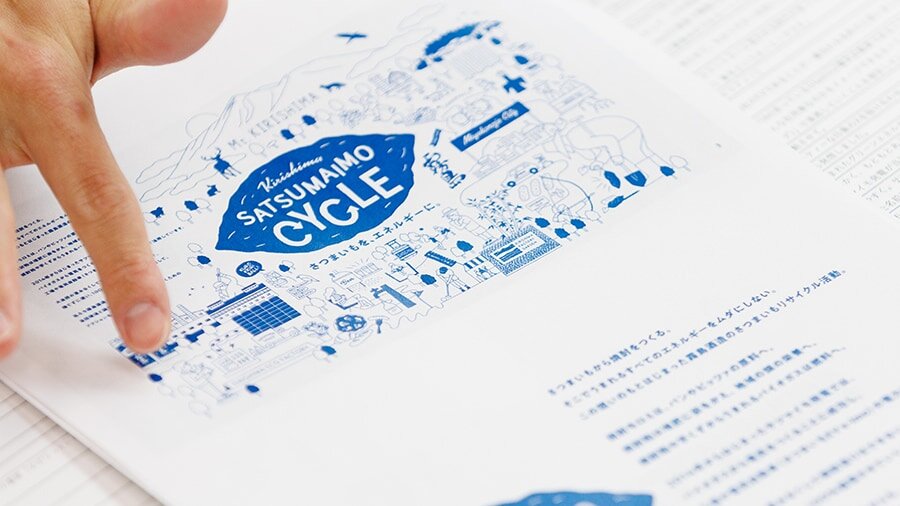
The illustrations not only show what is happening now, but also what the near future holds and even dreams of what the world could be like, adding to the fun.
"It would be great if we could use Sweet Potato Power Generation to create playground equipment that children can play on safely," says Hayashi.
"It would also be fun to use the warm wastewater, concentrate the carbon dioxide produced during biogas generation to create carbonated baths, or to make Kurokkiriball with that carbon dioxide," says Hasegawa.
Reflecting the staff's passion for the environment and community, e-imo has become popular with children at environmental classes held by Kirishima Shuzo at elementary schools.
"Using e-imo's electricity, we've made popcorn with an electric heater or powered spot coolers in summer to keep everyone cool. The kids really enjoy it," says Hayashi.
The e-imo also plays a useful role in times of disaster. Kirishima Shuzo has signed an agreement with Miyakonojo City, allowing it to be used as a power source in times of disaster. One e-imo unit can apparently provide 24-hour power to a shelter for 200 people.
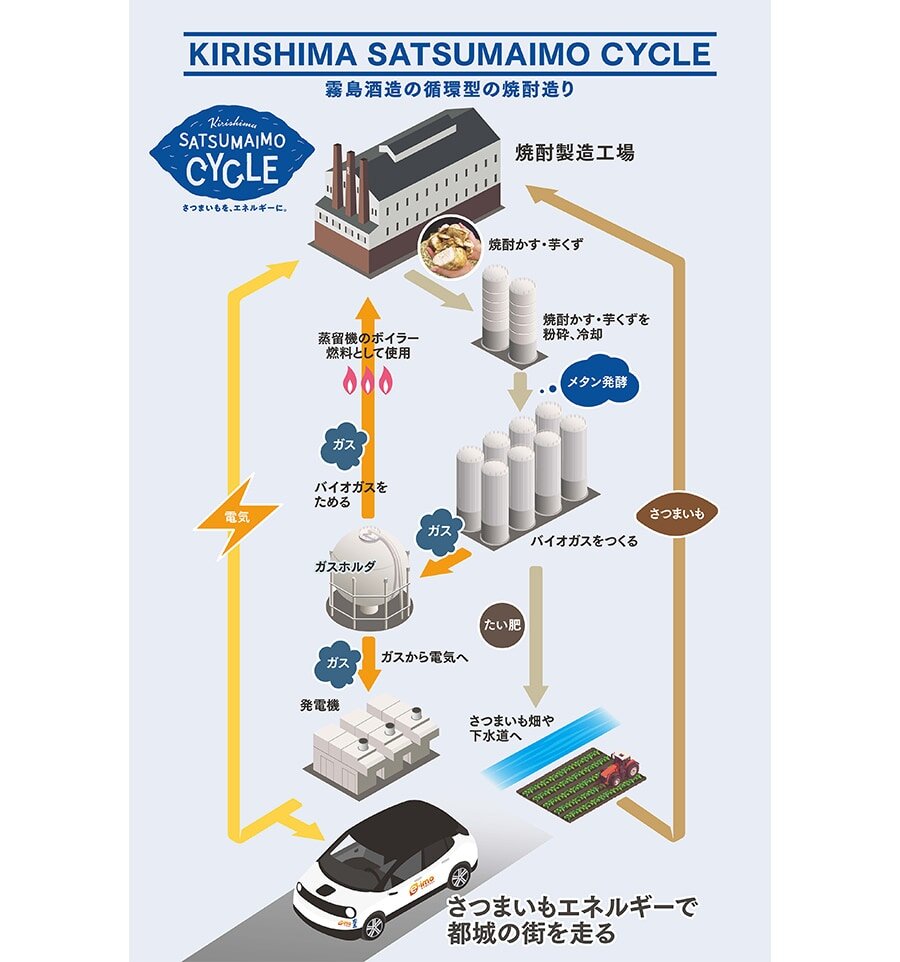
Through the announcements of KSC, which has taken on many new challenges, including e-imo, Kirishima Shuzo's attitude towards disseminating information is beginning to change.
"I've had opportunities to work with the Green Energy Department before, but through the cross-departmental KSC initiative, I was reminded once again how amazing the department responsible for our company's environmental activities is. I realized the importance of finding valuable information in seemingly mundane tasks," said Hasegawa.
"Shochu is not just about the physical taste; I think it tastes even better when you have a story behind it. I would like to continue to put effort into providing information so that customers can enjoy shochu," says Hayashi.
Sweet potatoes, water, and koji are all gifts from nature. These become shochu, bring joy and vitality to people, and after a great cycle, the next shochu is born. This is the vision that KSC shows. For Kirishima Shuzo, engaging in environmental activities has always been and will continue to be a "natural" thing.



*Please refrain from sharing alcohol-related information with those under 20 years old.

- From hashtags
Interesting articlesSearch for