There are people who map out the invisible "flavor."
Flavor map.
This is an important measure that connects customers with new shochu discoveries.
Kuro Kirishima, Shiro Kirishima, and Akane Kirishima — Kirishima Shuzooffers16 brands of sweet potato honkaku shochu*.
"When choosing Shochu, everyone has their own preferences and requests, such as 'I don't like strong potato scents' or 'I want to drink something with a strong aroma.' We thought that if we had a 'Flavor map', customers themselves would be able to choose shochu that suits their tastes," recalls Yu Okado of the Quality Management Department.
*As of July 2024

There are many different types of sweet potato shochu, but no two taste the same; each has its own unique character. Kirishima Shuzo has several "flavor maps" that clearly summarize the differences.
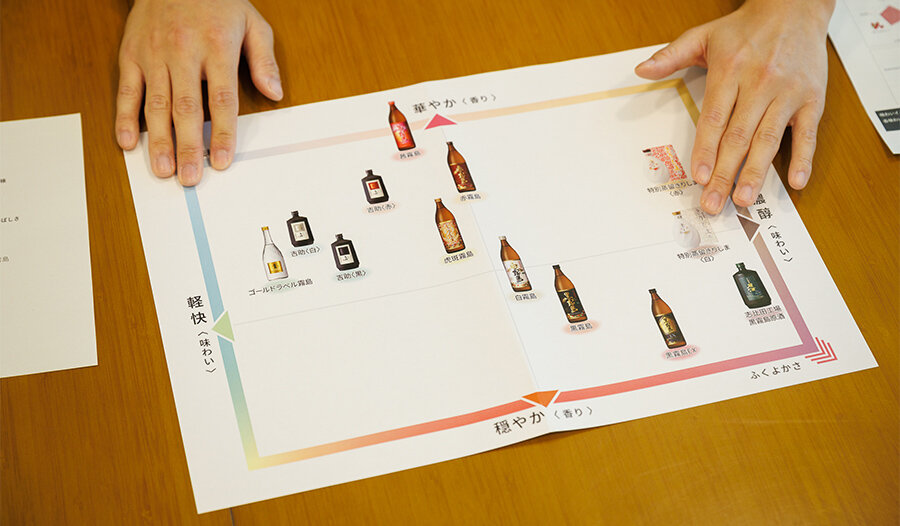
One example is a positioning map for sweet potato honkaku shochu, which is made up of two axes, one vertical and one horizontal. The vertical axis indicates whether the aroma is "gorgeous" or "mild," while the horizontal axis indicates whether the taste is "light" or "rich." The map shows that the taste is more refined as you move to the top left and more full-bodied as you move to the bottom right, making it easy to see at a glance the distinctive aromas and flavors of each product.
"Flavor is something that cannot be seen, and is a very vague thing that is perceived differently by different people. That's why we needed a 'yardstick' that would allow everyone to share that taste. 'Visualizing taste' is an important mission for Kirishima Shuzo," says Okado.
Let's take a look at the actual flavor map.
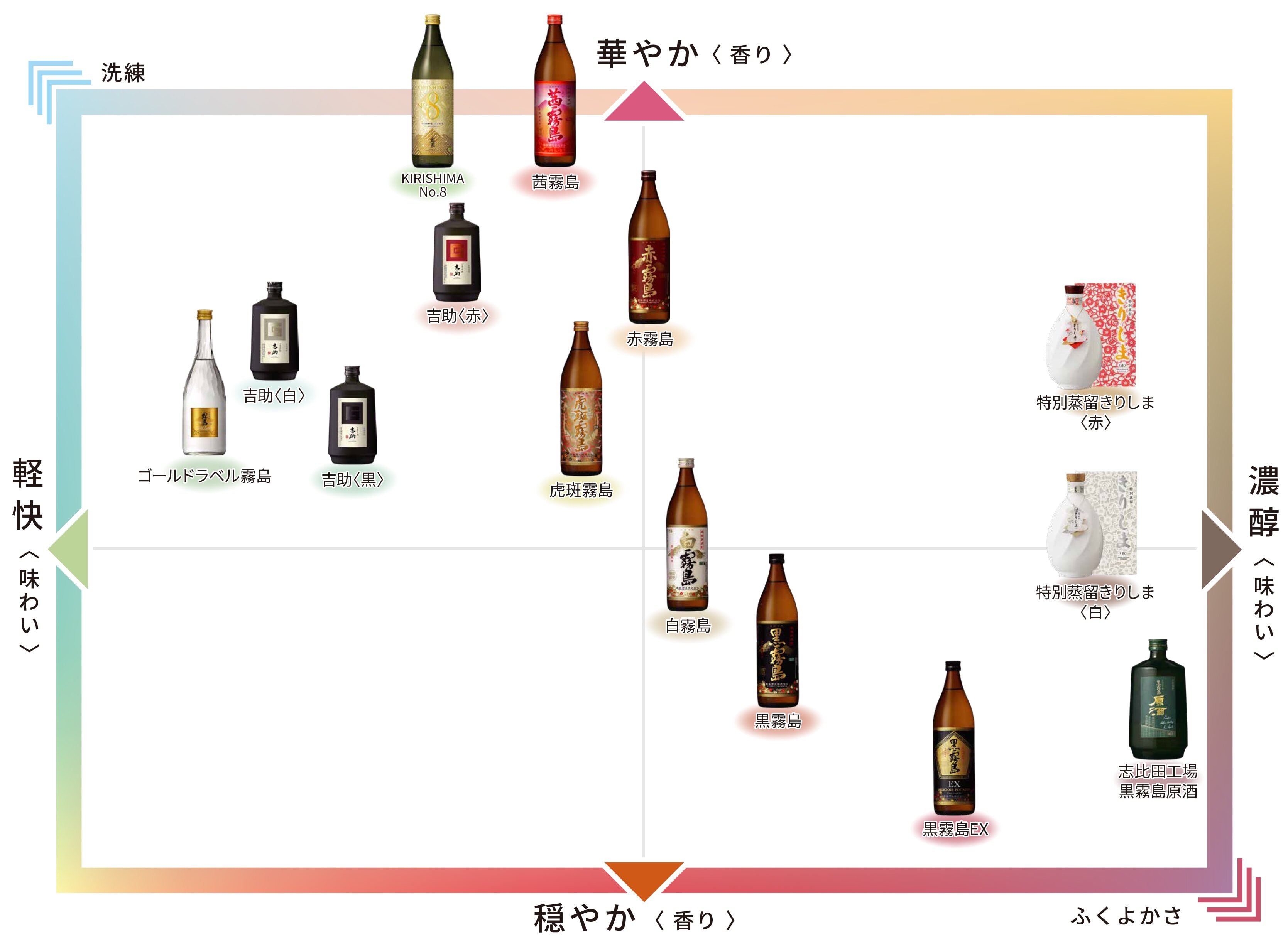
*This map does not include all Kirishima Shuzo products.
*As a general rule, products are compared at an alcohol content of 25%. While some products differ in strength, those below 25% tend to feel lighter, whereas those above 25% are perceived as richer and more full-bodied.
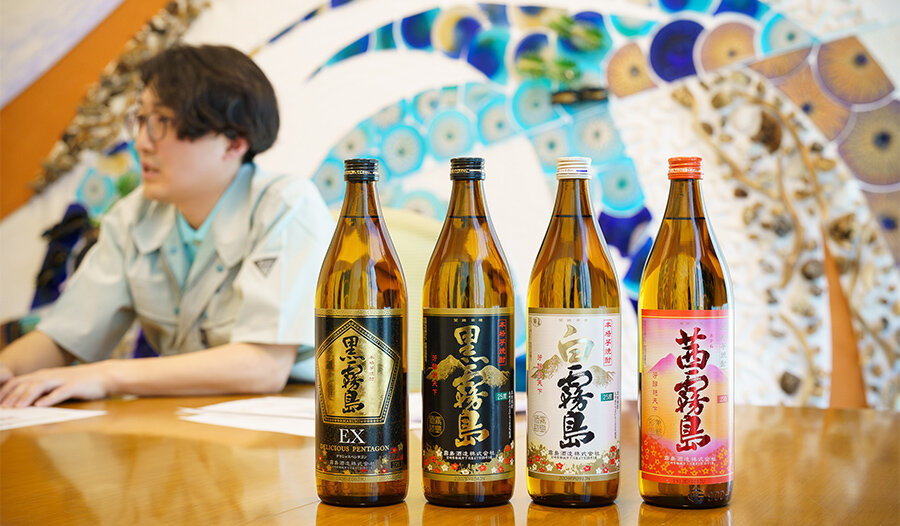
For example, Kuro Kirishima is located somewhere in the middle, with its aroma leaning towards "mild" and its flavor leaning towards "rich." It has a refreshing taste that pairs well with a variety of foods, but it also features the aroma of the sweet potato used as an ingredient and the fragrant aroma unique to shochu, which is why it's located slightly to the bottom right of the map.
Compared to Kuro Kirishima, Kuro Kirishima EX has a richer aroma and flavor typical of sweet potato shochu, so it is positioned even further to the bottom right.
Shiro Kirishima, though made from the same sweet potatoes as Kuro Kirishima, uses a combination of white koji and yeast to pursue an exquisite balance of sweetness, umami, and roundness, resulting in a smooth mouthfeel. This is why it is located near the center of the map.
Akane Kirishima uses a sweet potato variety called Tama-Akane, and is characterized by a peach and orange-like aroma. For this reason, it is located in an area with a high "gorgeous" level on the map.

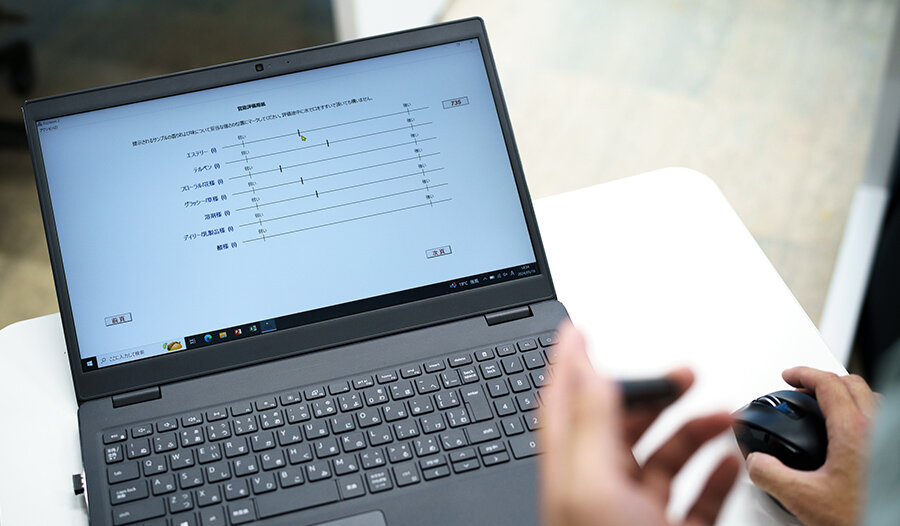
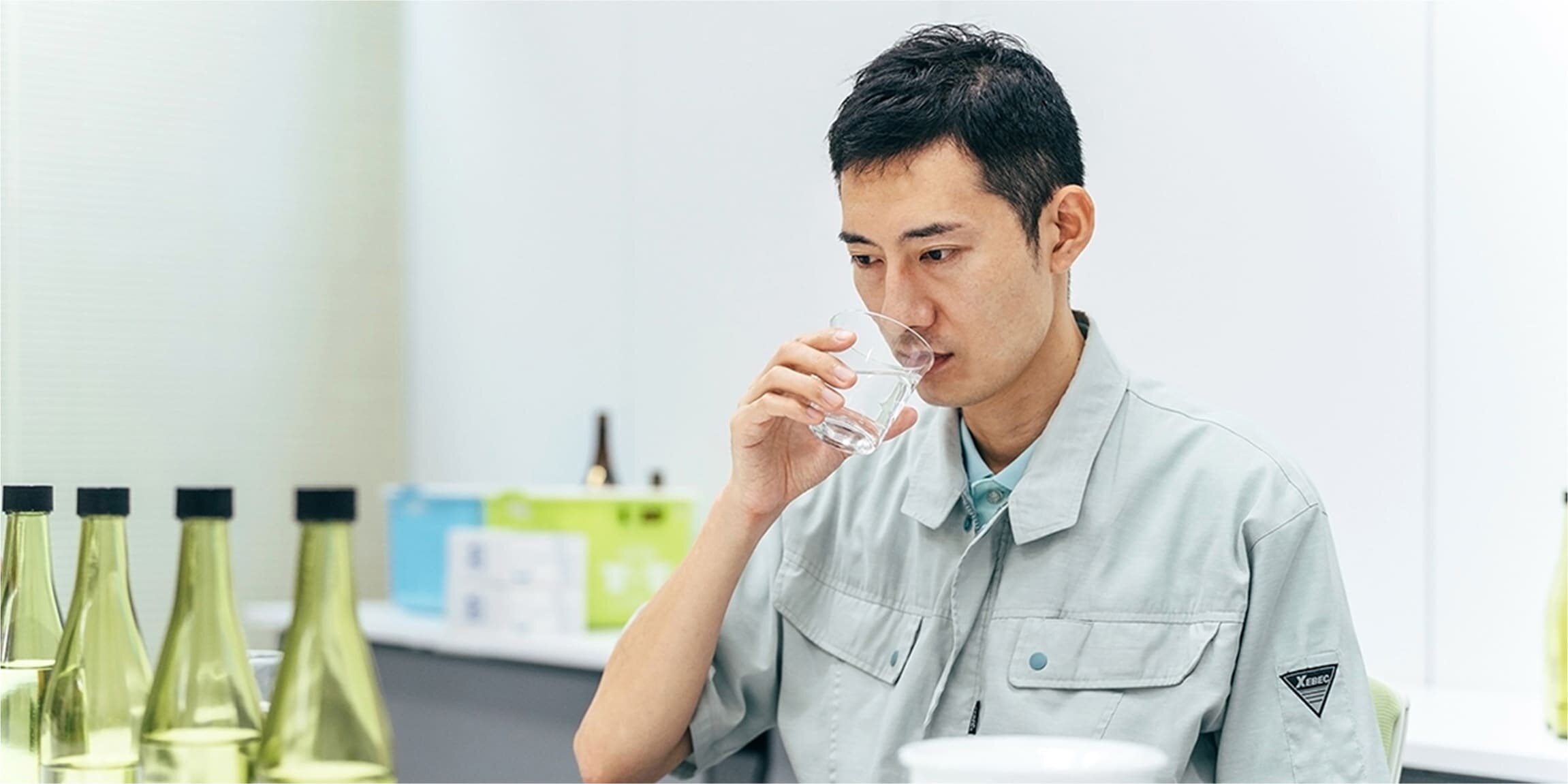
Kirishima Shuzo's flavor map was created based on "sensory evaluation" using the nose and tongue of several evaluators, including Okado. Products are actually tasted and evaluated using 19 "flavor words" and their "strength."
The "flavor words" are words that Kirishima Shuzo has independently defined based on its accumulated experience, and they are quite varied. While "sweet potato aroma" is easily imaginable, specialized terms like "estery" (evoking apple or melon) also appear. While these are hard for an amateur to imagine as characteristics of shochu, they are able to distinguish between the diverse flavors and aromas with their noses and tongues.
"For example, for the evaluation item 'sweet potato aroma', the strength is quantified and rated, such as 77 for Shochu A, which the tasters perceive as strong, and 18 for Shochu B, which they perceive as weak. We then consolidate the evaluation data from all evaluators into a single set."
Ultimately, this data is mapped onto a two-axis chart for easy understanding by customers and employees. However, reaching this final map requires detailed analysis.
In addition to providing an opportunity for customers to learn about the features of the products, a flavor map also serves as a common "yardstick" for all Kirishima Shuzo employees.
When developing and marketing new products, comparing the flavors of new products against existing ones helps design distinctive aromas and tastes, creating differentiation. In particular, new product development involves employees from various departments, so standards and indicators for aroma and flavor that are commonly recognized by all involved are necessary.
Therefore, in the future, they aim to create a more objective and stable flavor map by combining human evaluations with machine-derived component analysis data. They also say that the "flavor words" they currently use will need to be continually revised to match the times and changing tastes, while also comparing them with objective analytical data from machines.

Whether it's at a storefront where someone is trying to choose their favorite shochu, or in a meeting room where a new shochu is being created.
The "flavor map" continues to serve as someone's "yardstick", clearly indicating flavor.




*Please refrain from sharing alcohol-related information with those under 20 years old.

- From hashtags
Interesting articlesSearch for