The words etched on the label. Behind them stood a family that has been putting their feelings into writing for three generations.
What is the enduring bond with the Matsuda family,
born from the "Kirishima" written approximately 70 years ago?
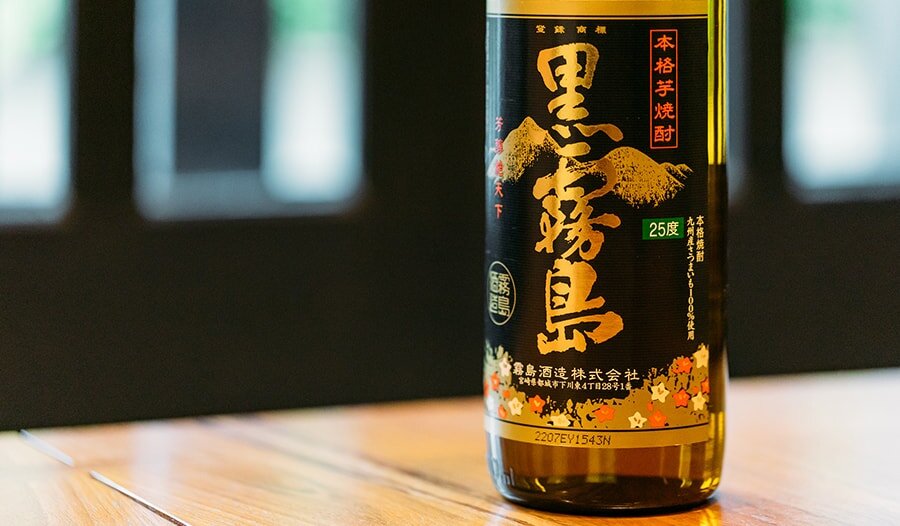
The Kirishima logo can be seen on shochu labels, on signs in downtown Miyazaki, and in the upper left corner of this website as well.
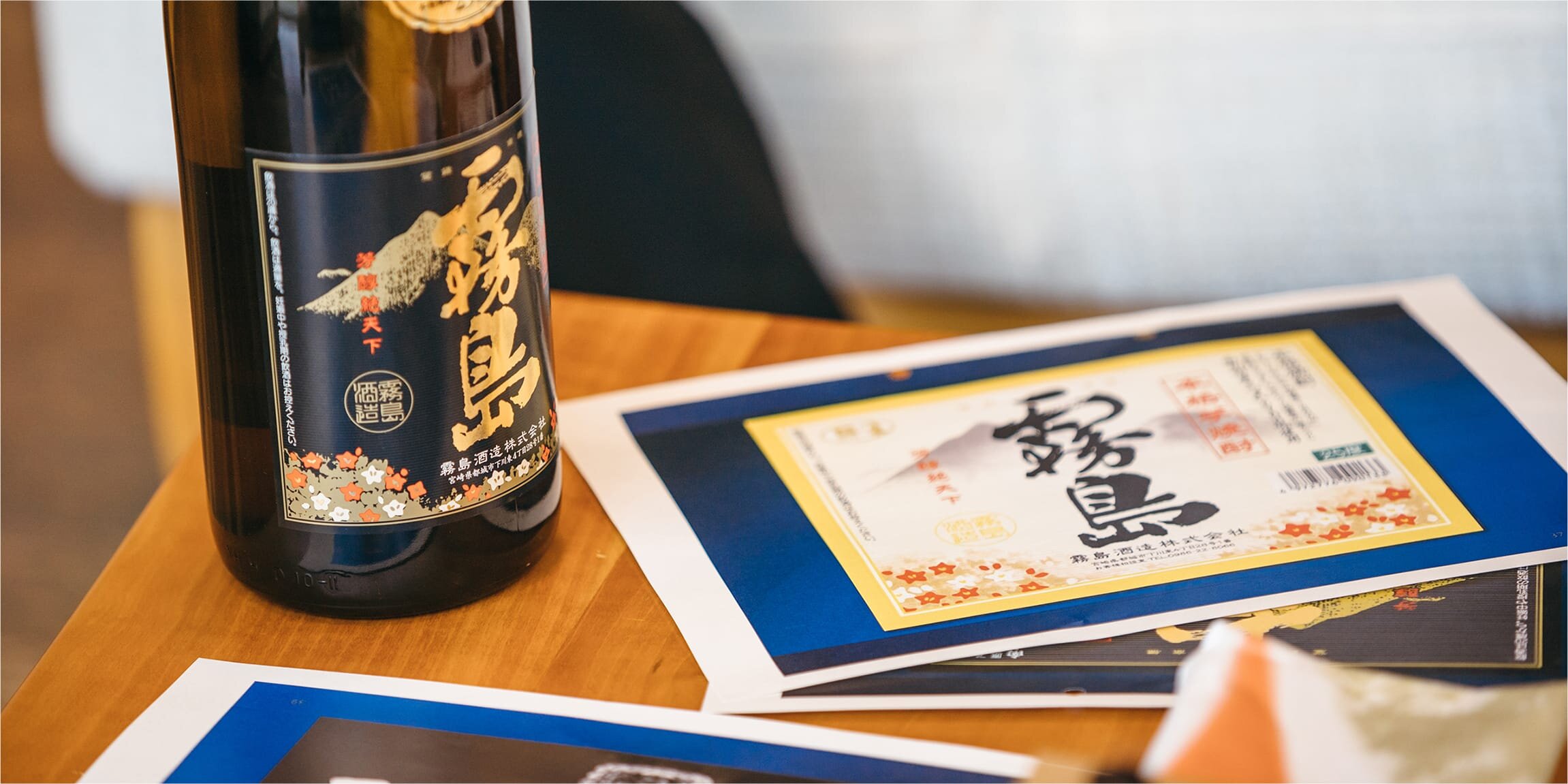
This iconic logo, which is sure to get you in the mood for an evening drink just by looking at it, was created approximately 70 years ago by the calligrapher Zuika Matsuda (the first generation).
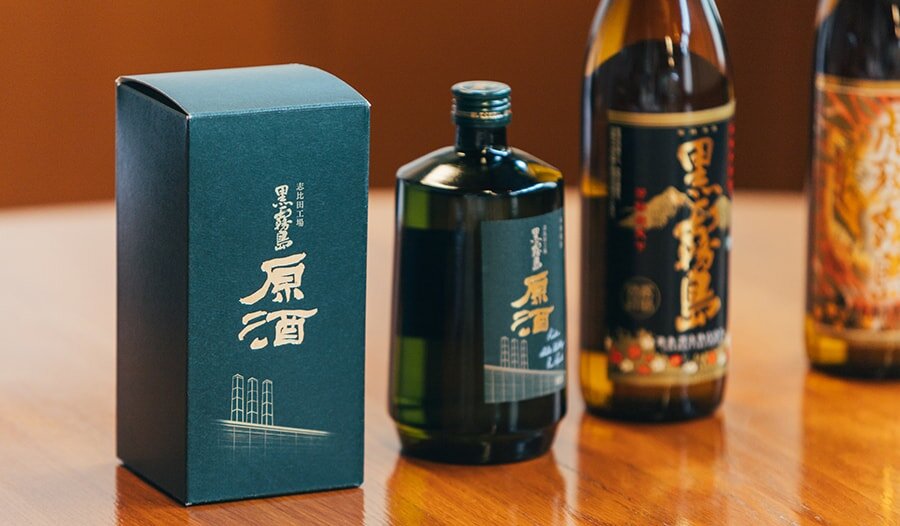
Furthermore, the "Kuro" in Kuro Kirishima and the "Aka" in Aka Kirishima are written by his son, Zuika Matsuda (2nd generation), while the "Torafu" in Torafu Kirishima and the "Genshu" in Shibitakojo Kuro Kirishima Genshu are written by his grandson, Zuiun Matsuda. This work has been carried out across three generations of the family.
We spoke with Zuiun Matsuda and Takuzo Enatsu, Managing Director of Kirishima Shuzo, about the thoughts behind the calligraphy logo, which can be said to be the face of Kirishima Shuzo, and the story behind its creation.
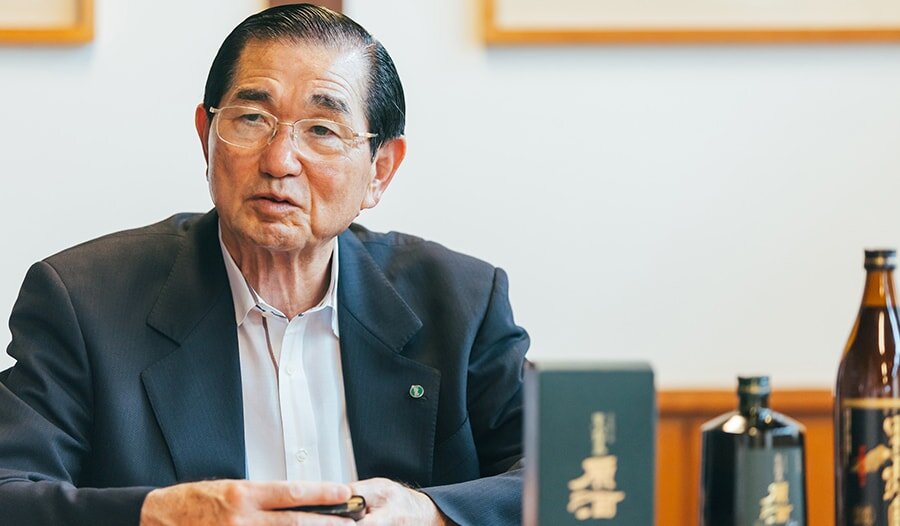
Around 1950-1960, it was Takuzo's father, Junkichi Enatsu, the second president of Kirishima Shuzo, who took the initiative to revise the "Kirishima" logo.
Until then, the company had used a logo with a so-called "bearded" font for "Kirishima", but Junkichi insisted on using calligraphy written by a calligrapher, which had strength and flexibility.
"The selection meeting was held in a Japanese-style room spanning over ten tatami mats, with about 10 calligraphers lined up and spreading out their calligraphy. My father carefully examined each piece, and the "Kirishima" written by Zuika Matsuda (the first-generation) was selected."
Takuzo, who witnessed the birth of "Kirishima" alongside his father Junkichi when he was just a child, recalls:
"I don't know what my father intended at the time, but the characters in 'Kirishima' are solid and powerful, yet flowing. The thoughts and intentions of the person who wrote them are embodied in them. Now I understand this is something the 'beard-style' font could never achieve."
Junkichi's passion and attitude towards design has been passed down to Takuzo even now, after all these years.
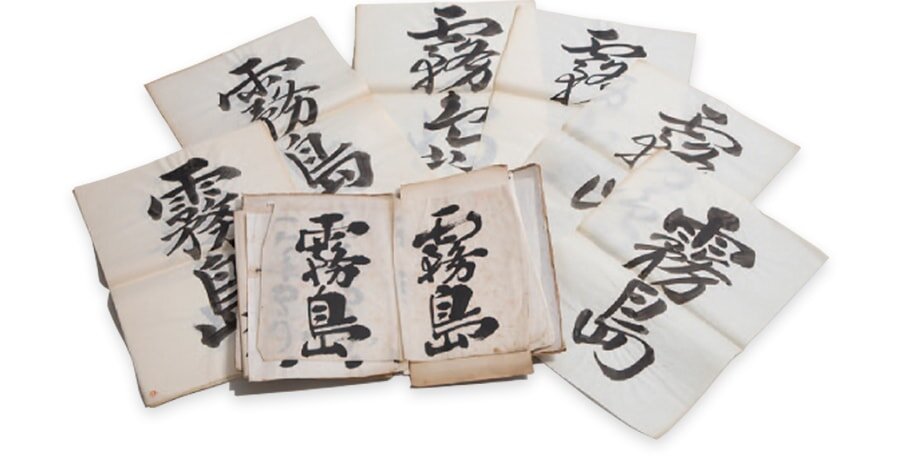
Meanwhile, Zuiun Matsuda first saw his grandfather's "Kirishima" characters when he moved to Miyazaki to start elementary school. They were on a signboard in the center of the town where he was about to start his new life.
"Ever since I first saw that sign, 'Kirishima' has always been a source of pride and admiration for me. Even to a child who couldn't read kanji yet, there must have been something about it that spoke to me."
Born into a family of calligraphers, his grandfather and father created the logo for Kirishima Shuzo. He wanted to follow in their footsteps. Unable to let go of this desire, Zuiun picked up his brush and wrote his thoughts in a letter addressed to Kirishima Shuzo. When Takuzo received the letter, he replied without hesitation.
"I had always hoped that Zuiun Matsuda would be next, so I was happy that he shared the same feelings."
The feelings that the Enatsu and Matsuda families had inherited from generation to generation intersected over time.
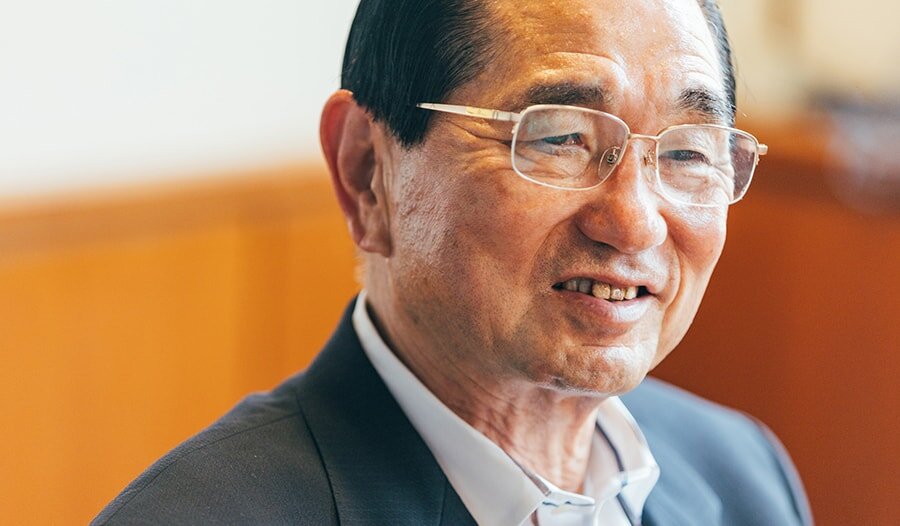
"I would like you to write as if you were your grandfather."
That was the order that Takuzo conveyed to Zuiun when he requested "Torafu Kirishima."
Keep the "Kirishima" characters as they were, and add two new characters for "Torafu" (meaning "tiger stripes") on top, ensuring it flowed seamlessly.
"It was something I had never tried before in my calligraphy practice, so to be honest, I struggled a lot," Zuiun recalls.
He analyzed his grandfather's "Kirishima" over and over again. He tried to understand it with his body, his mind, his intuition, and his logic, with all his heart and soul. Takuzo, the client, also refused to compromise. He worked with Zuiun through repeated trial and error, and it took him 3,000 sheets of washi paper to come up with the logo currently used on the label.
"My grandfather passed away when I was very young, so we never had the opportunity to talk about calligraphy, but as I studied 'Kirishima,' I felt as if I was having a conversation with my grandfather through it. I began to understand what he must have been thinking when he drew the brush strokes, and what the intention behind each stroke must have been. It made me very happy."
It was a conversation only possible because Zuiun was a family member, and it is also a testament to the strength of the feelings Zuika put into "Kirishima."
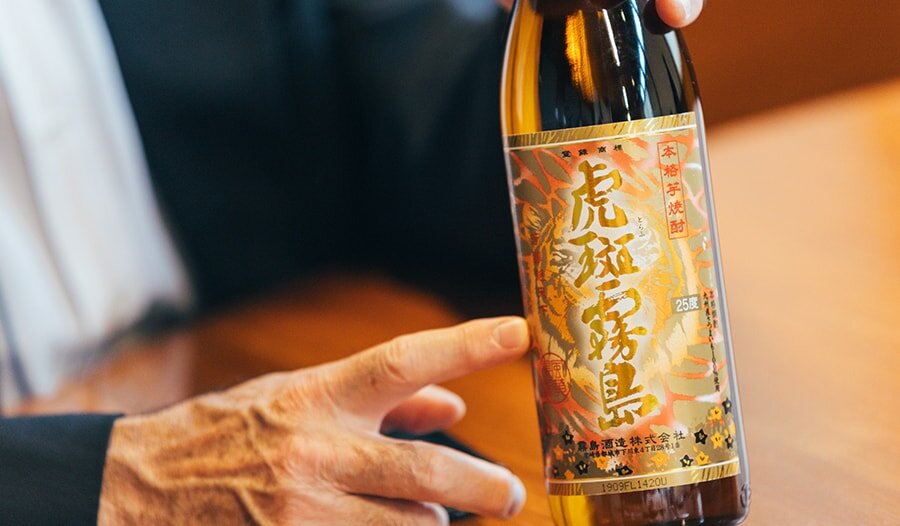
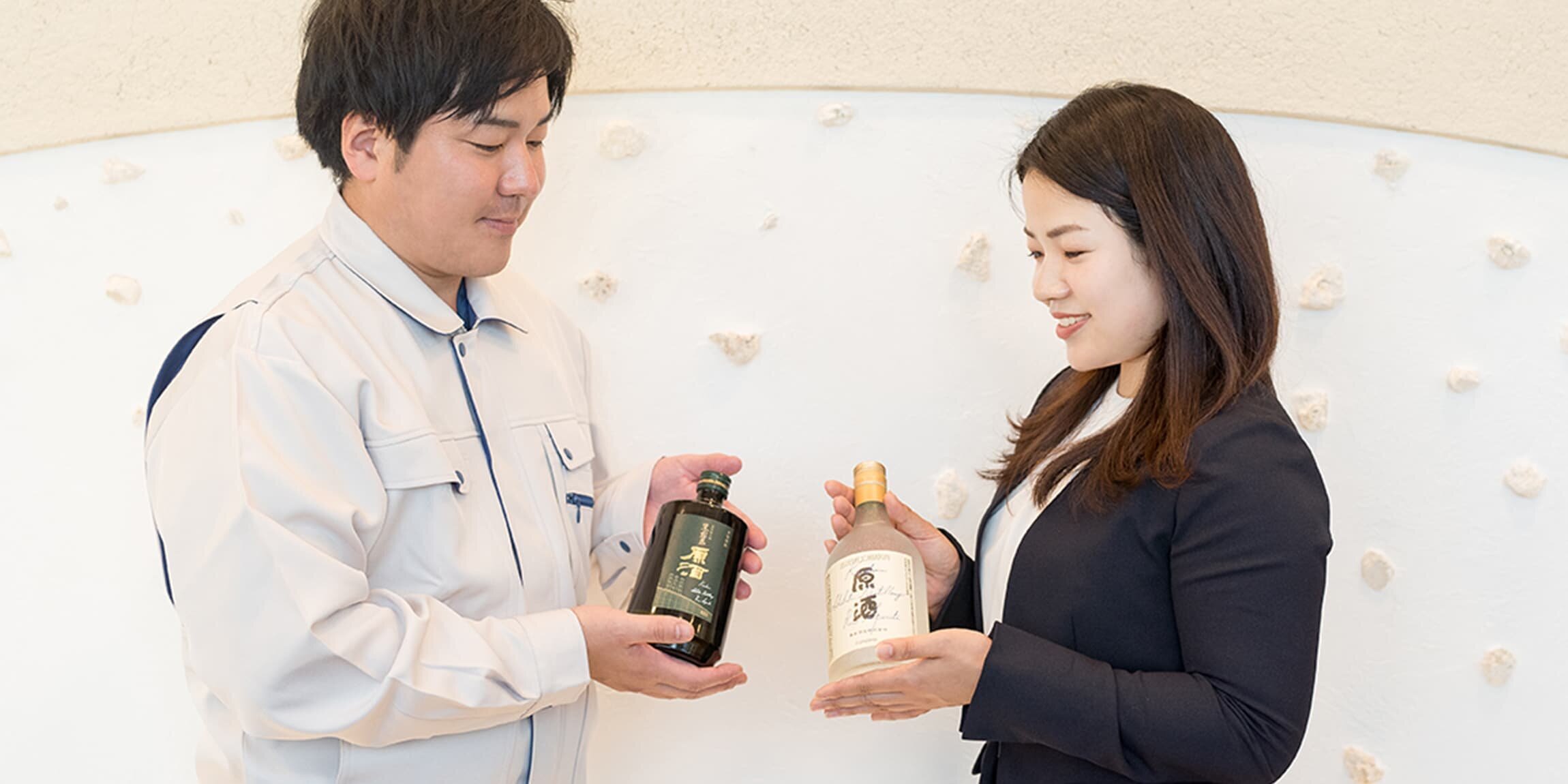
Zuiun Matsuda was also asked to write the word "Genshu" in the name "Shibitakojo Kuro Kirishima Genshu."
Based on the shared understanding between Takuzo and Zuiun that "an image that exudes oldness and dignity is a good fit," the logo was completed based on a calligraphy style reminiscent of the "clerical script**2 typeface used on wooden tablets**1which has an old-fashioned feel with slightly upward-sloping lines that give it a dynamic feel.
For Zuiun, this was a collaboration spanning three generations: his grandfather, who wrote "Kirishima," and his father, who drew "Kuro," and himself.
*1 Wooden tablet: A long, thin wooden board used for writing with ink.
*2 Clerical script: one of the Chinese character writing styles
Takuzo says the following about the current writing of "Kirishima."
"Seeing the character '霧' ("kiri" in "Kirishima," meaning "mist") evokes mist. Seeing '島' ("shima" in "Kirishima," meaning "island") evokes an island. Kanji characters are made up of pictures that represent the shapes of things. They're not just symbols; the kanji themselves contain meaning. I believe that the only way to express this is through characters written with a brush by a human being, with a strong will. This has been conveyed to those who see it and has been loved, and that's why Kirishima Shuzo is still here today, with the characters for 'Kirishima' at its base."
The "Kirishima" logo began with the hand of a single calligrapher and has been passed down through generations along with the passion it embodies. It will continue to be an unwavering symbol of Kirishima Shuzo, both now and in the future.



*Please refrain from sharing alcohol-related information with those under 20 years old.

- From hashtags
Interesting articlesSearch for